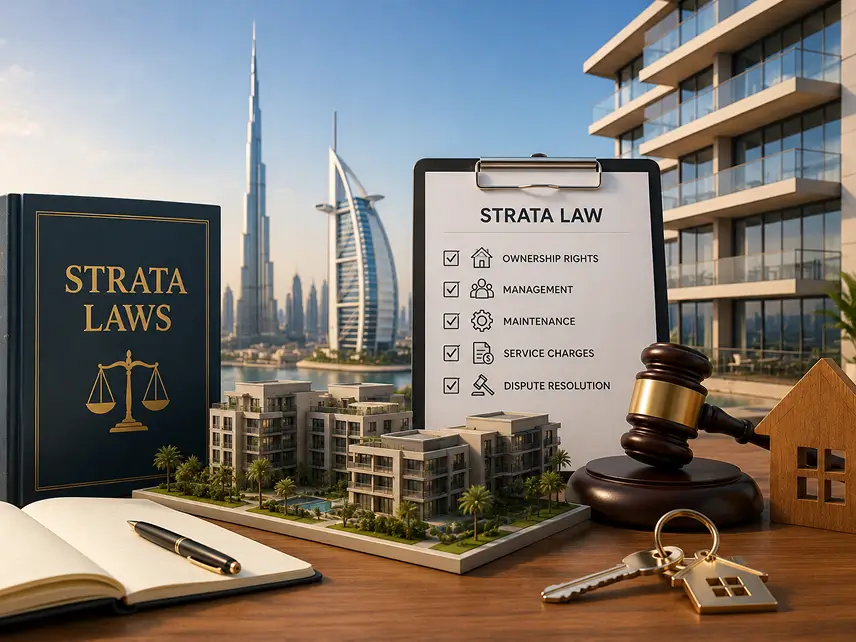
If you jointly own an apartment, villa, or unit in Dubai, you will have heard continuing discussions about the updated Dubai Strata Law. And if you are wondering what these changes are, then you are not alone. Many property owners share your concerns and are actively seeking clarity on how these updates might affect them.
The Strata Law regulates how jointly owned assets such as residential buildings and residential communities are managed and maintained. It affects everything from service fees to your rights as an owner, and how to maintain common areas.
Understanding Dubai’s Strata regulations is important to protect your investment and avoid preventing potential issues in the future.
In this blog with GLLIT, we will break down everything you need to know as a property owner – what is new, what has changed, why it is important, and how you can stay compliant and prepared.
What is Strata Law and why does it matter to Dubai property owners?
Before we get into what has changed, let’s get the basics right.
- Strata Law regulates shared ownership – if you have assets in a building or community, you automatically share ownership of common places like corridors, gym, pool, garden, and parking.
- It looks after how these common areas are managed – from budgeting to selecting the management company, to charging service fees.
- It also protects communities through the establishment of clear guidelines on rights and responsibilities and resolving disputes.
Major changes under the new Dubai Strata Law
Dubai’s Strata Law was first introduced in 2007. It laid the foundation for how jointly owned properties, like apartment buildings and villa communities, are managed and maintained. In 2019, Dubai updated this law to make things fairer, more transparent, and better protected for property owners.
The following are important changes under the new law:
- Developers have reduced long-term control: After handover, the management of the property is no longer in the developer’s hands, but is instead transferred to OAs or management companies approved by Dubai’s Real Estate Regulatory Agency (RERA), as required by Dubai’s Jointly Owned Property Law (Law No. 6 of 2019).
- The OAs are recognized and empowered: Property owners can establish an OA with legal authority to manage common areas, oversee maintenance, and make decisions on behalf of all owners.
- Compulsory registration of all joint ownership properties: All buildings or communities must be registered to ensure regulatory oversight under the Dubai Land Department (DLD).
- Strict control over service fee: The service fee should be audited and approved, keeping the owners of Dubai property from inappropriate or excessive fees.
- Rules on dispute settlement: New procedures enable owners of jointly owned properties in Dubai to resolve complaints faster and in a more transparent manner through RERA.
- Developers must meet stricter financial standards: Before a project can proceed, developers are now required to prove they have the financial capacity to deliver it, reducing the risk for buyers and owners.
- Non-compliance now has real consequences: Developers and management companies that don’t follow the rules face heavier fines, suspension, or loss of their approvals entirely.
How does the new Strata Law affect Dubai property owners
These changes directly affect you as an owner of a jointly owned property.
- Increased voice in community matters: Owners now have the right to vote for management companies and budgets.
- Improved transparency on service fees: Owners are now entitled to an accurate breakdown of the service charge and can dispute improper claims.
- Common areas are everyone’s responsibility: Owners share the responsibility of ensuring that shared spaces, lobbies, gyms, pools, gardens, and parking, are properly and regularly maintained.
- Protection against overcharging: All service fees must be fair and audited before the owners are billed.
- Fast dispute resolution: Complaints and disputes can now be officially dealt with through procedures defined under RERA.
- Relief if you have outstanding fees: Through RERA’s Tayseer Initiative, owners with overdue service charges can apply for a flexible payment plan of at least six months rather than facing immediate penalties.
- Your finances are protected long term: Management companies are required to maintain a reserve fund for major future repairs, so unexpected large costs don’t fall entirely on owners overnight.
- Everything is trackable digitally: Through the Dubai REST app, you can verify your property title, track transactions, and stay updated on your community’s status in real time.
Important things owners should start doing
To stay ahead and protect your investment under the new Dubai Strata Law, here are a few things you can do:
- Get yourself familiar with your Owners’ Association: Understand who speaks on your behalf and is actively engaged in community management.
Check your service charges on Mollak: Log in to the Mollak portal using your unit details to see a full breakdown of your charges. If something looks off, raise it with your management company or escalate to RERA. - Download the Dubai REST app: Verify your property title, check your community’s registration status, and stay updated on anything affecting your property — all in one place.
- Participate in community votes: Your vote on budgets and management decisions directly affects the quality of services you receive and how much you pay.
- Settle outstanding fees through Tayseer: If you have overdue service charges, RERA’s Tayseer Initiative lets you pay them off through a flexible plan of at least six months.
- Stay informed on new regulations: Dubai’s property laws are evolving fast. Following DLD and RERA updates ensures you remain compliant and protect your property’s value.
Common misunderstanding about the updated Dubai Strata laws
Since the changes in Dubai’s Strata laws were introduced, there have been some myths in circulation. Let’s clear them:
- Developers still have control over everything: This is incorrect. Once your building or community is handed over, management legally transfers to an Owners’ Association or a RERA-approved management company. Developers have no ongoing authority over how your community is run.
- Owners do not have any voice about service fees: Quite the opposite. Every service charge must be reviewed and approved by RERA before it reaches you. You can access your full breakdown on Mollak anytime and formally dispute any charge that doesn’t add up.
- It takes years to settle disputes: This is not true. Dubai’s RERA has introduced a quick and more organized way to resolve disputes.
- Service fees are arbitrary, there is no real oversight: Every dirham is tracked. Management companies must submit budgets through Mollak, get RERA approval, and have their accounts audited. Owners have full visibility into how funds are used.
- I can ignore overdue service fees: Ignoring them can lead to penalties. However, if you are struggling, RERA’s Tayseer Initiative exists specifically to help, offering a structured repayment plan rather than immediate consequences.
Conclusion
Understanding Dubai’s Strata Law is not just about compliance. It is about knowing your rights and using them. The 2025 and 2026 updates from DLD and RERA have put real power in the hands of property owners. The tools are there: Mollak, the Dubai REST app, the Tayseer Initiative. You just need to know how to use them.
Stay informed, engage with your Owners’ Association, and keep an eye on your service charges. That is how you protect your investment and your peace of mind. At GLLIT, we help property owners navigate these regulations with confidence. Whether it is a service charge dispute or understanding your rights, we are here to help. Get in touch with GLLIT today.